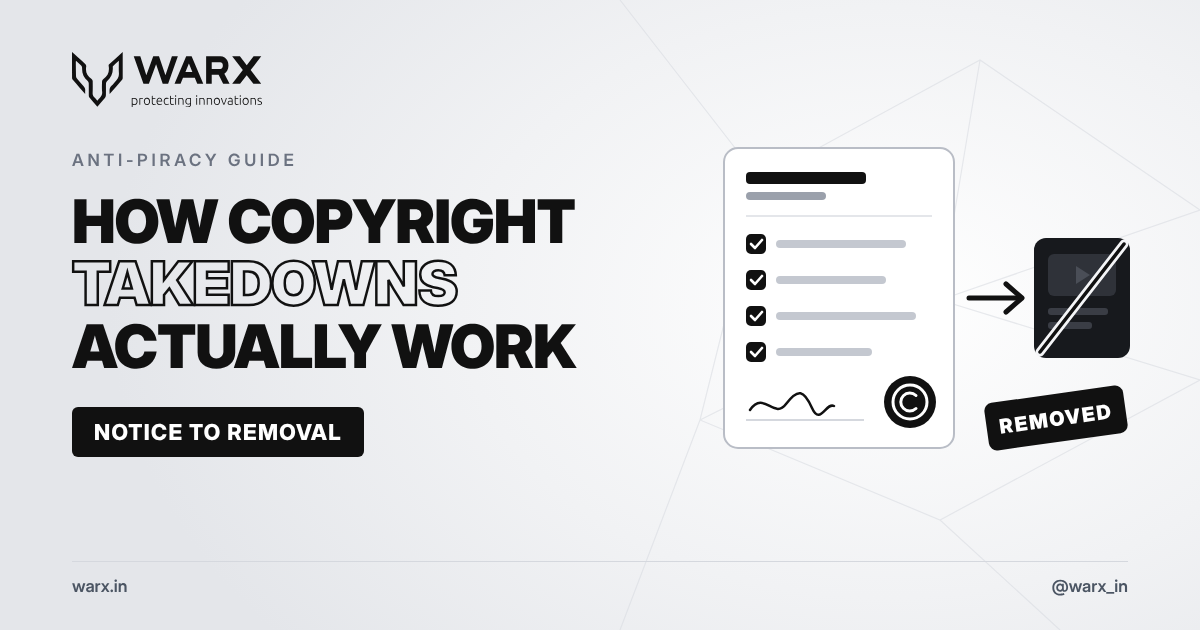
When your film, music, course or software appears online without permission, you don't need to go to court to have it removed. Most websites, platforms and hosting companies have a process for removing copyright-infringing content when the rights owner reports it. This is called a copyright takedown. Done right, it is the fastest and cheapest way to remove pirated content.
What is a copyright takedown?
A copyright takedown is a formal request asking a platform to remove content that uses your work without permission. The request is called a takedown notice. Platforms act on these notices because the law in most countries protects them only if they remove infringing content once they are told about it.
You can send a takedown notice for almost any creative work you own, including:
- Films, TV shows and web series
- Music and audio
- Books, e-books and course material
- Software and apps
- Photos, artwork and designs
What a takedown notice must include
Platforms reject incomplete notices, so getting the details right matters. Most platforms ask for:
- Your details: name, company, address, email and phone number, or those of the agent acting for you.
- The original work: what you own, such as the film title, with a link to the official version if one exists.
- The infringing content: the exact URL of each page, file or post. A general link to a whole website is usually not enough.
- A good-faith statement: that you believe the use is not authorised by you, your agent or the law.
- An accuracy statement: that the information in the notice is accurate and that you are the owner or authorised to act for the owner.
- Your signature: a physical or electronic signature.
Where to send takedown notices
Pirated content usually lives in several places at once. Send notices to each of them.
- The platform: YouTube, Facebook, Instagram, Telegram, X and most other platforms have their own copyright reporting forms.
- The hosting provider: for standalone piracy websites, the company hosting the site can remove the content or the whole site.
- File-sharing and cyberlocker sites: these host the actual video or audio files and usually have an abuse or copyright contact.
- Search engines: Google and Bing can remove infringing pages from their search results, so people searching for your work find legal options first.
- App stores and marketplaces: for pirated apps, software or digital products.
What happens after you send a notice
- Review: the platform checks that the notice is complete and valid.
- Removal: if it is, the platform removes or disables the content, often within hours or a few days.
- Notification: the person who uploaded the content is usually told about the removal.
- Counter-notice: if the uploader believes the removal was a mistake, they can send a counter-notice. The content may be restored unless the rights owner takes further action.
- Repeat infringers: many platforms close the accounts of people who receive repeated copyright complaints.
Common mistakes to avoid
- Vague links: always list the exact URL of each infringing page or file.
- Missing proof of ownership: keep your rights documents ready, especially if you are acting for someone else.
- Reporting content you don't own: false notices can lead to legal liability and damage your credibility with platforms.
- Sending one notice and stopping: pirated content is re-uploaded constantly, so takedowns must be continuous.
Why speed and scale matter
Pirated content spreads fastest in the first few days after release. One copy on a popular site can be copied to hundreds of others within hours. That is why serious anti-piracy work combines:
- Constant monitoring to find new copies as soon as they appear
- Fast, complete notices sent to every platform at once
- Search engine removal, so pirate links stay out of results
- Tracking of repeat uploaders and the sites they use
Sending notices by hand works for a few links. For a film release or a large music catalogue, it needs a dedicated team and the right tools.
How WarX handles takedowns
WarX finds and removes pirated films, music, books, courses and software across websites, torrents, cyberlockers, Telegram, social media and search engines. Our team monitors around the clock, sends complete takedown notices on your behalf, and follows up until content is removed. We also track re-uploads and repeat offenders. A live dashboard shows every detection and removal.
Learn more about our anti-piracy services, or contact our team to start removing pirated content.
Frequently asked questions
Do I need a lawyer to send a takedown notice?
No. Rights owners or their authorised agents can send takedown notices directly. Legal advice helps for complex cases, counter-notices or court action.
How long does a copyright takedown take?
Many platforms act within hours to a few days of receiving a complete notice. Search engine removals and smaller websites can take longer.
Can someone send a takedown notice for me?
Yes. An authorised agent, such as an anti-piracy company, can send notices on your behalf. This is common for film studios, music labels and publishers who need takedowns at scale.
If this is already happening to a title or a brand you represent, talk to our anti-piracy services or Contact.